Launch
Voyager 1 begins its journey from Cape Canaveral, Florida.
NASA • INTERSTELLAR MISSION
THE FARTHEST JOURNEY
Launched in 1977. Past Jupiter and Saturn. Beyond the heliosphere. Humanity’s most distant spacecraft continues its journey through interstellar space.
01 • THE JOURNEY BEGINS
Voyager 1 lifted off atop a Titan IIIE–Centaur launch vehicle on September 5, 1977. Its faster trajectory carried it toward two giant worlds—and eventually beyond the protective bubble created by our Sun.
What began as a planetary flyby mission became one of humanity’s longest-running scientific journeys.
LAUNCH • CAPE CANAVERAL
NASA records Voyager 1’s launch at 8:56 a.m. local time from Florida, beginning a mission that would eventually reach interstellar space.
NASA launch record ↗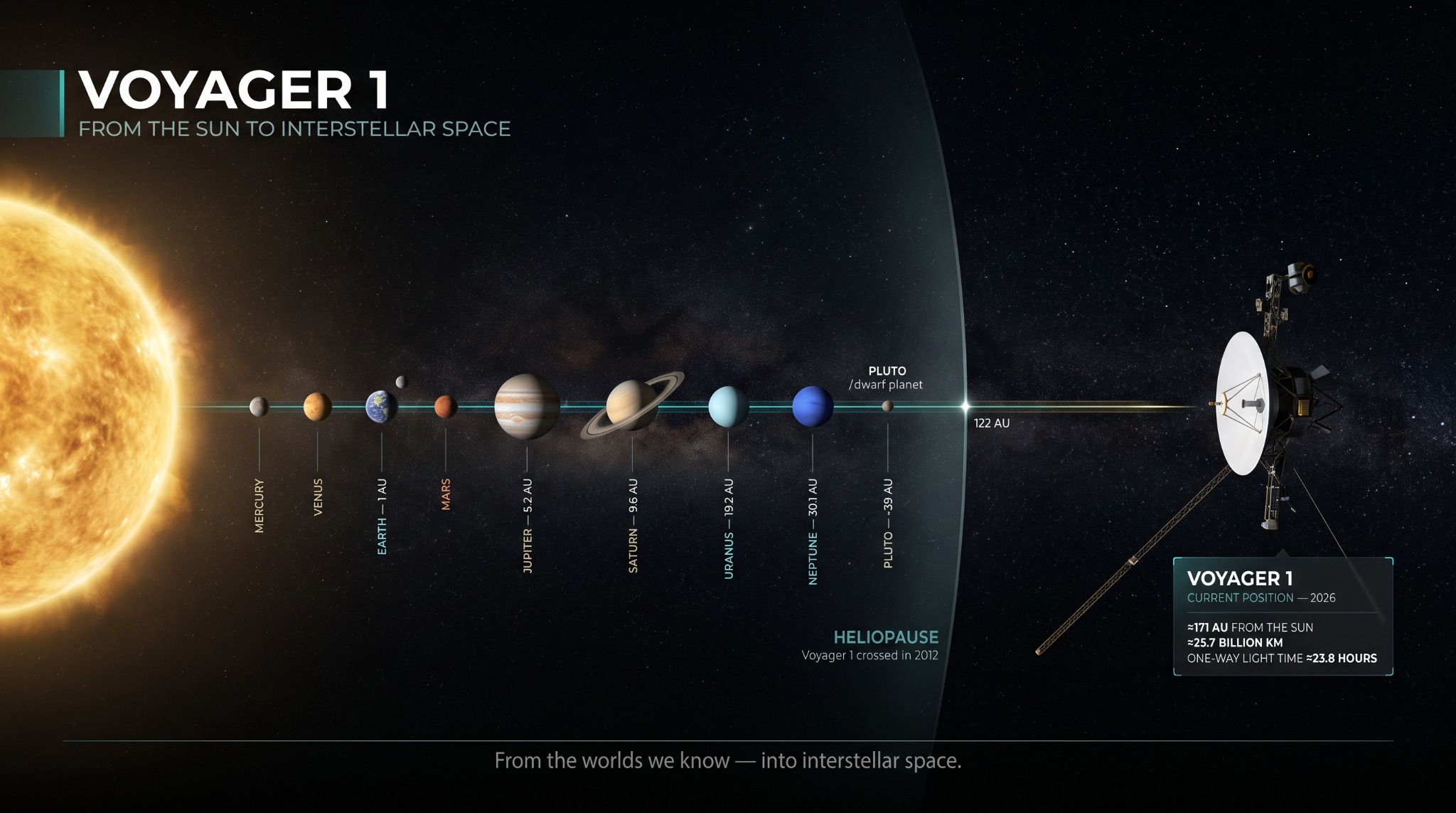
MISSION TIMELINE
Voyager 1 begins its journey from Cape Canaveral, Florida.
Closest approach reveals a dynamic giant planet, rings and previously unknown moons.
The final planetary encounter sends Voyager 1 onto its path away from the planets.
Voyager 1 captures Earth as the Pale Blue Dot before its cameras are switched off.
Voyager 1 crosses the heliopause and becomes the first spacecraft in interstellar space.
Science instruments continue studying the environment beyond the heliosphere.
02 • JUPITER
Voyager 1’s 1979 encounter transformed our view of Jupiter. The mission discovered a thin ring and two new Jovian moons, Thebe and Metis.
CLOSEST APPROACH • MARCH 5, 197903 • SATURN
At Saturn, Voyager 1 found new moons and a new ring. Its close encounter with Titan shaped a trajectory that carried the spacecraft away from the planetary plane.
CLOSEST APPROACH • NOVEMBER 12, 198004 • ONE LAST LOOK HOME
On February 14, 1990, Voyager 1 looked back toward the inner Solar System. From roughly 6 billion kilometers from the Sun, Earth appeared as a tiny speck within scattered sunlight.
Thirty-four minutes after the Earth images were taken, Voyager 1 powered off its cameras forever—saving energy for the long mission ahead.
Explore the Pale Blue Dot →05 • BEYOND THE HELIOSPHERE
On August 25, 2012, Voyager 1 crossed the heliopause—the boundary where the Sun’s particle-and-magnetic-field bubble gives way to interstellar space.
Voyager 1 and Voyager 2 remain the only spacecraft to have operated outside the heliosphere.
LISTEN • PLASMA WAVES
Voyager 1’s Plasma Wave Instrument detected electron-plasma oscillations in the interstellar medium. The spacecraft transmitted the measurements to Earth; because the frequencies fall within the human audio range, the data can be amplified and played through a speaker.
NASA/JPL-Caltech/University of Iowa • Public-domain NASA media
06 • THE GOLDEN RECORD
Mounted aboard Voyager 1 is a 12-inch gold-plated copper record—a time capsule designed to communicate something of Earth’s life and culture to any spacefarer that might one day encounter it.
The English greeting was recorded by six-year-old Nick Sagan, Carl Sagan’s son, for the Voyager Golden Record.
07 • LIVE POSITION
Position data is requested from NASA/JPL Horizons, cached by WordPress, and animated between server refreshes.
— AU • one-way light time —
— km
relative to Earth
Launched 5 Sep 1977
Connecting to JPL Horizons…
NASA official Voyager tracker ↗NASA projects Voyager 1 will reach the one-light-day distance milestone on November 18, 2026.
HABIB.AT • VOYAGER 1
Nearly half a century after leaving Earth, Voyager 1 continues through interstellar space—carrying instruments, memories, and a message from home.